
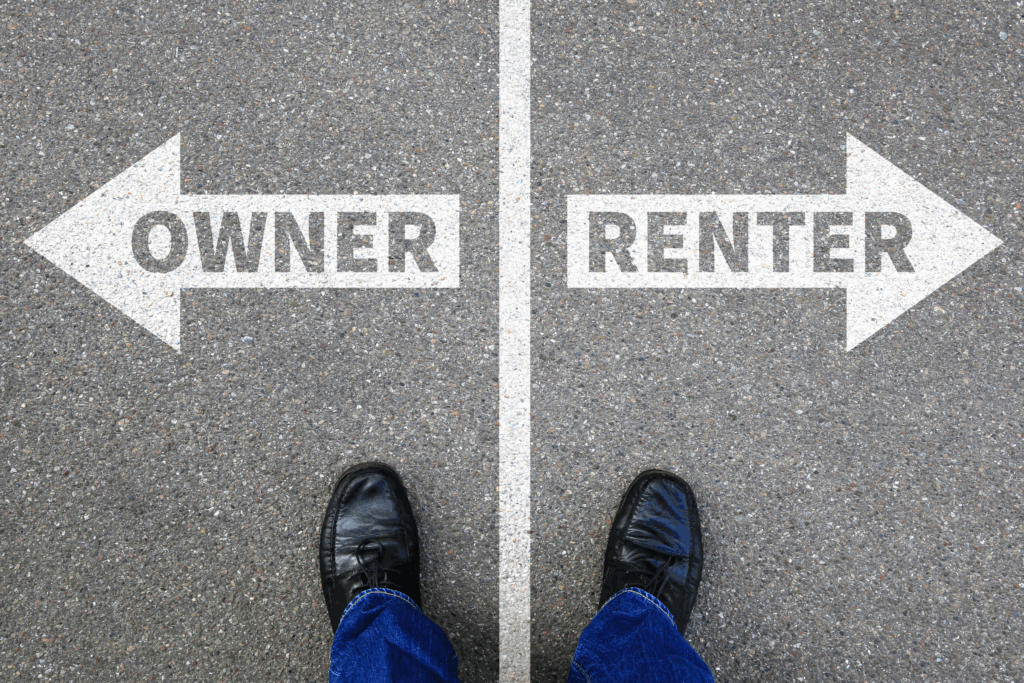
Few financial decisions carry more weight in Los Angeles than the choice between buying and renting; and few cities make that choice harder to work through clearly. Home prices consistently rank among the highest in the country, rental rates reflect the same pressure, and the variables that shape the right answer shift depending on where you are in your career, how long you plan to stay, and what the market is doing at any given moment. There’s no universal answer here, but there is a way to think through it with the kind of clarity that cuts through the noise.
Why the Rent vs. Buy Decision Hits Differently in Los Angeles
The rent-versus-buy question exists in every market, but Los Angeles puts its own specific weight on it. The city’s median home price consistently sits well above $800,000 and in neighborhoods like Santa Monica, Culver City, and West Hollywood, that number climbs significantly higher. At those price points, the upfront cost of buying isn’t just a hurdle; it’s a genuine barrier that shapes who can enter the market and when.
That same pressure operates on the rental side. Los Angeles renters don’t have the luxury of a cheap monthly alternative while they wait out the market. Rents in most of the city’s desirable neighborhoods can run $2,500 to $5,000 or more for a one- or two-bedroom apartment, which means even renting isn’t leaving money on the table in any simple sense; it’s trading one set of costs for another.
What makes Los Angeles especially important to analyze carefully is the scale of the numbers involved. A miscalculation about timing, affordability, or long-term plans costs more here than it would almost anywhere else. Getting the decision right, or at least grounded in accurate information, matters proportionally more.
The True Cost of Buying in Los Angeles
One of the most common mistakes buyers make is anchoring to the monthly mortgage payment as the primary cost metric. The actual cost of buying a home in Los Angeles is broader and, in several cases, meaningfully higher than the mortgage alone.
The components worth building into your analysis include:
- Down payment — Conventional financing typically requires 10–20% down. On an $850,000 home, that’s $85,000 to $170,000 in upfront capital before closing costs are factored in.
- Closing costs — Typically 2–3% of the purchase price in California, covering title, escrow, lender fees, and transfer taxes. On a mid-range LA purchase, that’s another $17,000–$25,000 out of pocket.
- Property taxes — California assesses property taxes at roughly 1.2% of the purchase price annually, with additional local assessments in some areas. On an $850,000 home, that’s approximately $10,000 per year — a cost renters don’t carry directly.
- Homeowners insurance — Standard in any market, but higher in Los Angeles due to fire risk exposure in hillside and foothill areas. Policies for homes in high fire hazard zones can run significantly above what comparable inland properties cost.
- HOA fees — Common in LA’s condo and townhome market, often ranging from $300 to $700+ per month depending on the building and amenities.
- Maintenance and repairs — A standard estimate is 1% of the home’s value annually, though older properties in LA can run higher. On an $850,000 home, that’s $8,500 per year in expected ongoing costs.
- Mortgage interest — At current rates, interest payments can represent a substantial portion of the monthly payment in the early years of a loan, particularly on a high-balance mortgage.
When these costs are stacked together, the monthly cost of ownership in Los Angeles frequently exceeds what a comparable rental would cost in the same neighborhood — sometimes substantially. That’s not an argument against buying; it’s the starting point for an honest analysis.
The Insider’s Guide To Leasing Commercial Space In Los Angeles (Free Guide)
What Renting Actually Costs and What It Doesn’t
Renting is often framed as money that disappears without building anything. That’s not quite accurate, and in Los Angeles, it’s worth being more precise about what renting does and doesn’t offer.
What renting provides is flexibility, predictability, and liquidity. You aren’t tied to a specific address for the length of a mortgage, you aren’t exposed to the costs of a major repair, and your capital remains available for other uses. In a city where careers and neighborhoods both evolve quickly, that flexibility has real value. Particularly for people who are newer to Los Angeles, still determining where they want to be long-term, or navigating a period of professional transition.
What renting doesn’t provide is equity. Every month of rent paid builds the landlord’s asset, not yours. In a market where property values have historically appreciated over time, that’s a meaningful gap — one that compounds over years in ways that can be difficult to quantify in real time but become very visible in retrospect.
The honest framing isn’t that renting is wasteful and buying is always better. It’s that renting carries opportunity cost, and buying carries carrying cost — and the question is which of those costs is more manageable given your specific situation, timeline, and goals.
Short-Term Affordability vs. Long-Term Equity: Where the Math Gets Complicated
The place where the rent vs. buy decision gets genuinely complicated in Los Angeles is the overlap between short-term cash flow and long-term wealth building. The two don’t move in the same direction at the same time, and understanding that tension is key to making a clear decision.
In the short term
Typically the first three to seven years of ownership — buying a home in Los Angeles often costs more on a monthly basis than renting a comparable property. Higher mortgage payments, property taxes, insurance, and maintenance all contribute. For buyers stretching to meet a down payment, that cash flow pressure can be real and persistent in the early years.
In the long-term
Los Angeles has historically been one of the more reliable markets for property appreciation in the country. Homeowners who purchased and held through multiple market cycles have generally built substantial equity — not just from appreciation, but from the gradual paydown of principal that accelerates over the life of a loan. That equity represents a compounding financial asset that renting, by definition, can’t replicate.
The practical question is whether you can absorb the short-term cost difference long enough to reach the point where equity and appreciation begin to outpace what you’d have accumulated by renting and investing the difference. That calculation depends heavily on how long you plan to stay — most financial analyses suggest that buying makes stronger sense when the ownership horizon is five years or more. Below that threshold, transaction costs alone can erode the advantage.
If you’re weighing a purchase alongside a potential relocation, our relocation guidance can help you think through how timing intersects with neighborhood and lifestyle decisions across the Los Angeles area.
The Insider’s Guide To Leasing Commercial Space In Los Angeles (Free Guide)
Tools and Methods for Running Your Own Analysis
The good news is that the rent vs. buy decision — while complex — is quantifiable, and there are frameworks that make it significantly more tractable.
The rent vs. buy LA calculator approach
Several online tools allow you to input purchase price, down payment, mortgage rate, expected rental cost, investment return assumptions, and projected appreciation to model the financial breakeven point. The New York Times has a well-regarded interactive version; the Consumer Financial Protection Bureau also offers a straightforward comparison tool. These aren’t substitutes for professional guidance, but they’re useful for stress-testing different assumptions before you get deeper into the process.
The price-to-rent ratio
A quick diagnostic tool: divide the purchase price of a home by the annual rent for a comparable property. A ratio below 15 generally favors buying; above 20, renting often pencils out better in the short term. In Los Angeles, ratios in high-demand neighborhoods can run 25 to 35 or higher — which is part of why the analysis here is more nuanced than in lower-cost markets.
True cost of ownership modeling
Rather than comparing mortgage to rent, model the full monthly ownership cost (mortgage principal and interest, taxes, insurance, HOA, and a maintenance reserve) against the rental rate. The gap between the two is the short-term cost premium of buying, and understanding that gap is essential for assessing affordability with accuracy.
Opportunity cost analysis
If you put your down payment into a diversified investment portfolio instead of a home, what return might you expect over the same period? This calculation is genuinely difficult to project, but it’s a meaningful part of the picture — particularly for buyers who are putting substantial capital down in a high-price market.
Break-even timeline modeling
Factoring in transaction costs, appreciation assumptions, and equity accumulation, most financial analyses suggest a minimum ownership horizon of four to seven years for buying to outperform renting financially in a high-cost market. If your plans are uncertain in that window, renting may be the more financially defensible position.
Working through these tools with an experienced agent who knows the local market adds a layer of calibration that the calculators alone can’t provide — local knowledge about which neighborhoods are appreciating, where inventory is constrained, and what buyers in your price range are actually competing for changes the numbers in ways that generic tools don’t capture. Browse our current listings to start getting a concrete sense of what your budget looks like across Los Angeles neighborhoods.
How Market Conditions Have Shifted the Calculation in Recent Years
The rent vs. buy decision in Los Angeles looks meaningfully different today than it did in 2020 or 2021 — and understanding why helps buyers interpret where things stand now.
Interest rates
The rapid rise in mortgage rates beginning in 2022, from historic lows near 3% to rates in the 6.5–7.5% range, significantly increased the monthly cost of carrying a mortgage in Los Angeles. A $700,000 loan at 3% carries a principal and interest payment around $2,950 per month; at 7%, that same loan costs closer to $4,650. That shift, applied to already-high LA home prices, pushed monthly ownership costs beyond what many buyers could comfortably absorb and kept some would-be buyers in rental housing longer than they otherwise would have been.
Housing supply
Inventory in Los Angeles has remained tight across most desirable submarkets. Limited supply has kept upward pressure on prices even as rate increases compressed affordability, creating a market where buying is both expensive and competitive. Sellers haven’t had the incentive to cut prices dramatically when qualified buyers remain active, even at higher rates.
Rent trends
Rental rates in Los Angeles increased substantially through 2021 and 2022 before moderating in some segments. While rent growth has softened in certain multifamily categories, rents in single-family home rentals and in high-demand neighborhoods have remained elevated. That compression — where renting isn’t cheap but buying is also costly — has made the decision genuinely difficult to optimize in the short term.
Emerging neighborhood dynamics
Some of Los Angeles’s historically less expensive submarkets have seen accelerated price growth as buyers have expanded their search radius in response to affordability constraints in core neighborhoods. Areas that offered clear price advantages a few years ago have narrowed that gap, which changes the rent vs. buy math in those specific locations.
The current environment doesn’t make buying wrong — it makes the analysis more important. Interest rates may ease over time, and buyers who enter at today’s prices with a long-term horizon still have access to the appreciation history that has characterized the LA market. But buying requires more preparation and more precise financial modeling now than it did when rates were near historic lows. You can explore service areas across Los Angeles to understand where the dynamics shift by neighborhood.
The Insider’s Guide To Leasing Commercial Space In Los Angeles (Free Guide)
Ready to Work Through the Numbers?
Buying versus renting in Los Angeles isn’t a question with one right answer — but it is a question you can answer clearly with the right framework, the right data, and an honest assessment of your timeline and goals.
At Lee West LA, our team works with buyers and renters at every stage of this decision, from the early analysis phase through to finding and closing on the right property. Whether you’re trying to run the numbers on a specific neighborhood, understand what your budget actually looks like in today’s market, or determine whether this is the right time to move from renting to owning, reach out to us to start the conversation. You can also start your home search, browse our current listings, or explore our full range of services to see how we support buyers throughout the process.


